
Open Dialogue Training and Workforce Capability Programs
Open Dialogue Training and Workforce Capability Programs
The Open Dialogue Centre offers a suite of evidence-based programs designed as a journey to build workforce capability for mental health, allied health, youth, justice, primary care and wellbeing services – or for anyone who wants to introduce Open Dialogue to their community.
Our faculty has extensive experience in applying and evaluating the approach in different contexts. Members of the faculty have been at the forefront of developing and implementing Open Dialogue in the UK and also involved in the multi centre randomised controlled trial ODDESSI (with research articles emerging in 2026).
We provide opportunities for continuous development with case studies, real-life scenarios, intervision/supervision and ongoing professional practice support – designed for workforce retention and better outcomes for people, families and community networks.
‘With Open Dialogue now popping up everywhere, I recognise the importance of a learning approach that has rigour and support from experienced facilitators as we implement it.’
Sally Thomas
Manager – Infant, Child & Youth Mental Health and wellbeing Services
Goulburn Valley Health
The Open Dialogue Centre offers a suite of evidence-based programs designed as a journey to build workforce capability for mental health, allied health, youth, justice, primary care and wellbeing services – or for anyone who wants to introduce Open Dialogue to their community.
Our faculty has extensive experience in applying and evaluating the approach in different contexts. Members of the faculty have been at the forefront of developing and implementing Open Dialogue in the UK and also involved in the multi centre randomised control trial ODDESSI (with research articles emerging in 2026)
We provide opportunities for continuous development with case studies , real-life scenarios, intervision/supervision and ongoing professional practice support – designed for workforce retention and better outcomes for people, families and community networks.
‘With Open Dialogue now popping up everywhere, I recognise the importance of a learning approach that has rigour and support from experienced facilitators as we implement it.’
Sally Thomas
Manager – Infant, Child & Youth Mental Health and wellbeing Services
Goulburn Valley Health
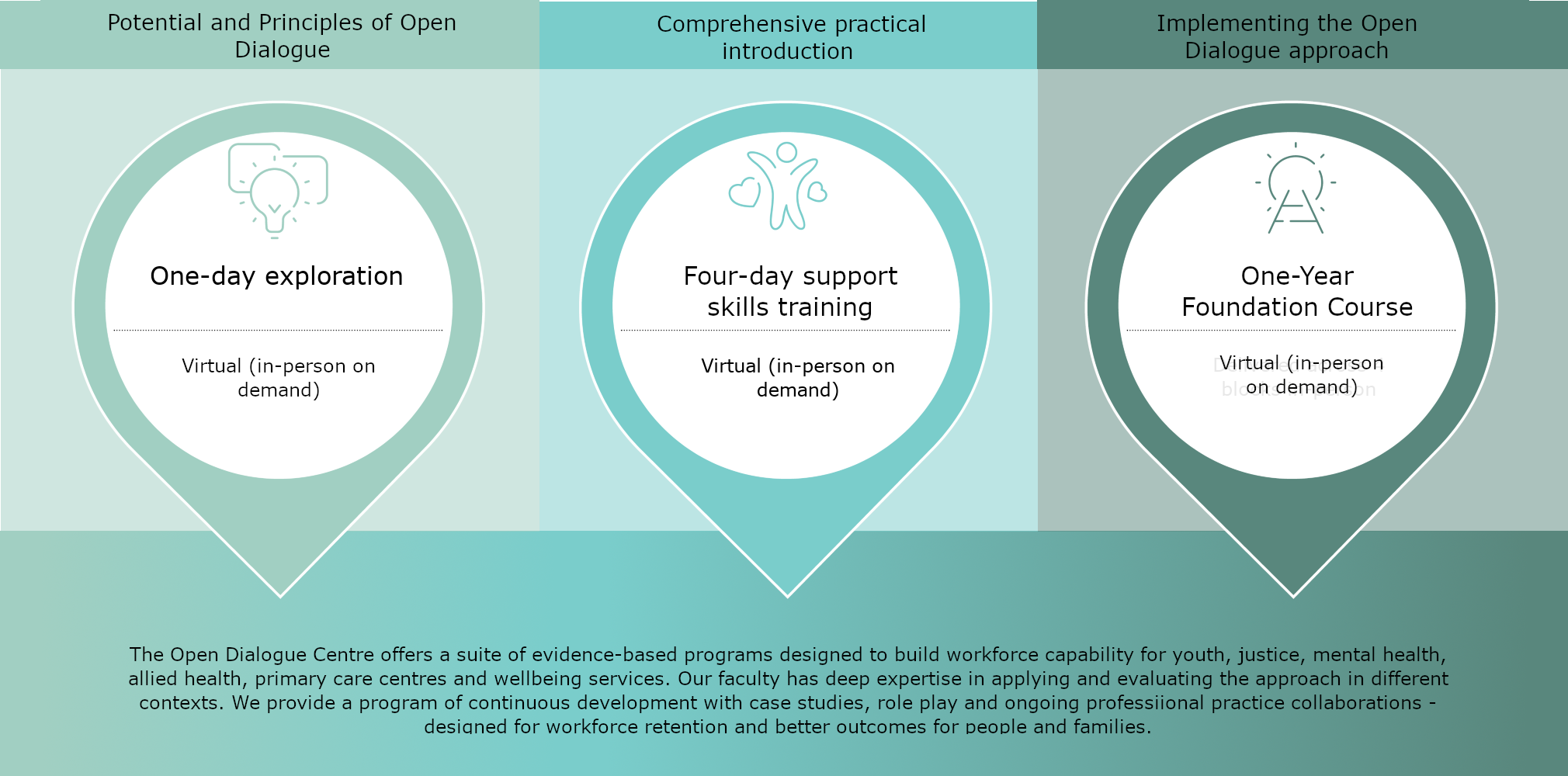
Click for direct access, or scroll to discover all Open Dialogue programs
Open Dialogue Key Principles
Understand how the Key Principles support Open Dialogue
One-Day Exploration
Potential and Principles of Open Dialogue
We invite individuals, service teams and organisational leaders to learn about Open Dialogue and how implementing the approach will strengthen professional practice, and build and retain your workforce.
Explore the skills and practice to understand what Open Dialogue can add to your work.
Gain an inspired overview of the origins, principles, elements, evidence base and application potential of the Open Dialogue Approach across different services and settings – in Australia and globally.
One-Day Exploration Outcomes
Develop your understanding of the positive outcomes for people, families and their social network.
Gain an understanding of what Open Dialogue is and why the World Health Organisation (WHO) references Open Dialogue as a way to address the many issues that are inherent in a bio-medically based mental health system.
Discover how Open Dialogue can support workforce transformation and coordination across services in a community.
Four-Day Skills Training
Comprehensive Practical Introduction
Designed for anyone with an interest in deepening their understanding of Open Dialogue and developing the basic skills needed to co-facilitate Open Dialogue network meetings.
This course can be a pathway towards becoming a fully trained Open Dialogue practitioner through our One-Year Foundation Course. The training is also appropriate for team members who want to support lead facilitators deliver network meetings. It is designed to engage services who want to work towards a whole-of-community response to mental health and wellbeing.
We encourage teams to train together. The Four-Day Skills Training and the One-Year Foundation Course can now connect to increase team consistency and engagement. See more about this in the OYFC outline below
Four Day Skills Training Outcomes
Learn how to become a co-facilitator in dialogical and relational practice within a network meeting through roleplays.
Deepen your understanding of the key elements of Open Dialogue practice, with real life examples and experiential learning sessions.
Expand your knowledge about the positive outcomes for people, families and their social network.
Support your team or organisation with the journey towards successful implementation of the Open Dialogue Approach.
Develop skills to assist with InterVision to support workplace welfare and self care.
Workshop real-life scenarios to understand how to put theory into practice.
One-Year Foundation Course (OYFC)
Becoming an Open Dialogue Practitioner
The One-Year Foundation Course (virtual or in-person) develops the skills, knowledge and confidence to facilitate Open Dialogue network meetings — whether you work in mental health, primary care, youth services or allied health and community services. With experienced trainers who were involved in the ODDESSI trial, you will also be supported to consider the practical requirements and operational changes needed to implement Open Dialogue across services and systems.
The course supports practitioners as they implement the Open Dialogue Approach in a way that is genuinely transformative for people, families and the service workforce
Flexible Delivery, designed around your work
The OYFC is delivered in sequenced blocks, structured to maximise learning and allow time for reflection and practice between sessions. It is primarily a virtual program, making it accessible to practitioners across Australia. It can also be delivered in-person for groups of 20-25, offering organisations the opportunity to train a cohort together and build shared capability from the ground up.
A natural step from the Four-Day Skills Training
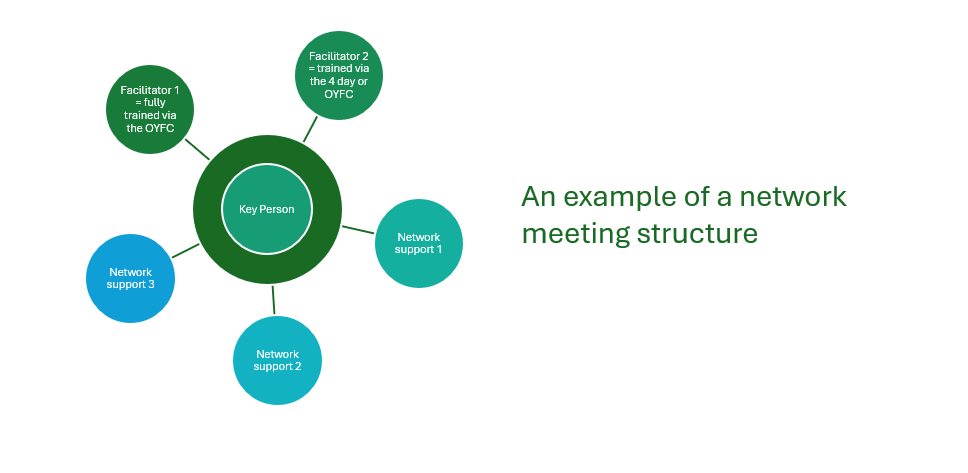
The first four days of the OYFC now run concurrently with the Four-Day Skills Training. This means services can train support facilitators and lead facilitators at the same time — building consistency and shared language across your team from day one.
For those who complete the Four-Day Skills Training and later decide they want to qualify as a lead facilitator, the pathway is straightforward: they simply join the next available OYFC cohort, picking up from day five.
Grounded in practice, shaped by experience
ODC’s faculty brings extensive experience translating Open Dialogue across practice, organisational, and community settings. Their knowledge comes from years of implementing, adapting, and refining the approach across vastly different services, with real experiences and examples.
A pathway to becoming a trainer
The OYFC is also the gateway to the Mentor in Training (MiT) program — an additional year of training and the first step towards becoming a qualified Open Dialogue trainer. To find out more, contact training@opendialoguecentre.org.au
OYFC learning outcomes
1. Develop confident and capable practitioners who can meaningfully implement the twelve key elements of dialogic practice into their work through facilitating network meetings.
2. Demonstrate a comprehensive understanding of the evolution, development and potential applications of Open Dialogue, and critically evaluate its potential for integration in diverse settings.
3. Integrate the knowledge and skills necessary to practice Open Dialogue as an ethical, human rights-based approach to mental health, demonstrating cultural competence and sensitivity by ensuring the person is at the centre of their care.
4. Evaluate thoughtfully the importance of lived and living experience and the value of peer support in service delivery, and develop strategies to effectively incorporate these elements into practice.
5. Explore how current services and people’s different identities and life experiences affect mental health and wellbeing, what this means for the care that is provided, and how the implementation of Open Dialogue can effect meaningful change.
6. Offer the ability to facilitate Open Dialogue informed network meetings to provide skills in reflective practice, deep listening and working with uncertainty, working towards aligning recovery-orientated and trauma-informed practice.
7. Develop mindful and compassionate self-awareness skills through reflective practice.
8. Support improved outcomes for the person whose needs are central and their network by being able to offer alternative practices where appropriate.
9. Support professional growth by adding Open Dialogue to your suite of offerings.
10. Be part of strengthening team support and service culture by using dialogical approaches in communications and collaborations within your workforce. This allows for improved continuity of care and responsive team work.
11. Lead network meetings and implement change within your team supported by another team member who has completed the OYFC or the Four-Day Skills Training.
12. Capability to lead intervision and self-work practice for your team.
Complementary support offerings
Please contact us via training@opendialoguecentre.org.au to discuss the following offerings:
Intervision/Supervision
We offer a variety of options for intervision/supervision to suit individual needs. Intervision/supervision is delivered by one of our experienced faculty.
Network Roleplays
While roleplays are an integral part of our training, additional and ongoing practice is pivotal to successful implementation of Open Dialogue network meetings.
Mentor-in-Training (MiT)
Our MiT program is for those who have completed the One-Year Foundation Course and wish to extend their training to begin the process of becoming an Open Dialogue Trainers or more experienced Open Dialogue Practitioners.
Implementation Support
Our Centre can support you through the entire process from concept to full utilisation of Open Dialogue within your service. Our implementation strategies along with a faculty experienced in implementing Open Dialogue within the ODDESSI trial offers the practical knowlege essential for implementation
Open Dialogue Centre Faculty
The Centre has an expanding faculty of Open Dialogue experts to deliver training. Guest topic experts are also engaged for particular modules.
Learn more about the faculty below.
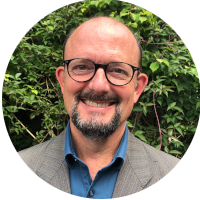
Mark Hopfenbeck is a Senior Trainer in Open Dialogue with the Open Dialogue Centre. Mark has spent the past 20 years training mental health teams in Norway, England, Portugal, Israel, and Czechia.
Mark is currently lead trainer for the Post-graduate Certificate in Peer-supported Open Dialogue offered by North East London Foundation Trust and City St George’s, University of London. Mark is also Program Director for the Post-Graduate Certificate in Peer-supported Open Dialogue, Systemic Practice and Relationship Skills at City St George’s. Mark spends most of his time collaborating with Open Dialogue researchers and practitioners around the world – supporting the development and dissemination of the Open Dialogue Approach. His core research interests have focused on integrating Open Dialogue with current models of recovery, collaborative care and peer support in order to facilitate the implementation of Open Dialogue within statutory mental health services as well as the development of organizational and clinical fidelity measures.
He is currently co-investigator involved in Open Dialogue: Development and Evaluation of a Social Network Intervention for Severe Mental Illness (ODDESSI) (2017-2025), and is a member of the Advisory Board for HOPEnDialogue: An International collaborative multicentre research network to support the Open Dialogue learning community and evaluate the effectiveness of Open Dialogue in various mental health care contexts around the world (2019-2027).
He is also Individual Project Partner at the Collaborating Centre for Values-based Practice in Health and Social Care, St Catherine’s College, University of Oxford and an Honorary Associate Professor in the Health Services Research and Management department at City St George’s, University of London. Mark is also Program Director for the Post-Graduate Certificate in Peer-supported Open Dialogue, Systemic Practice and Relationship Skills at City St George’s.
Mark is co-editor of The Practical Handbook of Hearing Voices (2021), The Practical Handbook of Eating Difficulties (2022) and The Practical Handbook of Living with Dementia (2022).

Tilly Read has extensive experience in Open Dialogue training. As a Community Practice Lead in the UK, Tilly has been instrumental in spearheading initiatives centred around Open Dialogue, including the ODDESSI Trial and Peer Supported Open Dialogue methodologies.
Tilly is from Devon in the UK and has been instrumental in designing training to support how teams plan, collaborate and foster culture change. She is a clinical practice lead who brings nearly a decade of experience as a registered mental health nurse. She develops ways to strengthen the understanding of how Open Dialogue can be transformative for organisations and the workforce, with deep knowledge around Peer Supported Open Dialogue, organisational clinical processes, better outcomes for people and families and guidance around developing truly person-centred approaches.
Tilly led the implementation of the ODDESSI trial in Devon. ODDESSI is a large randomised control trial in the UK, researching the effectiveness of Open Dialogue in crisis and continuing metal health care within the National Health Service in the UK.
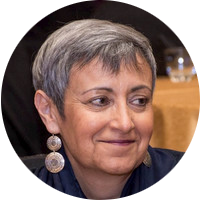
Yasmin Ishaq is a relational psychotherapist, social worker and Open Dialogue trainer and clinical supervisor who brings decades of experience working in the UK public sector in a way that is trauma-informed, family-inclusive and strengths-based.
Yasmin was the Open Dialogue lead for mental health services in Kent as part of the NHS in the UK until 2021. she also developed previous new initiative to start the Early Intervention in Psychosis Service in East Kent in 2005 and the primary care mental health social work service in 2015.
From 2016 – 2021, Yasmin led the first standalone NHS Open Dialogue service in the UK, and evidenced that the approach could be developed, sustained, and provide positive outcomes for individuals and families accessing specialist mental health services.
Her approach incorporated the principles of Open Dialogue in a way that elevated a non-judgmental emphasis around understanding individuals and families within a cultural, social, psychological and environmental context.
Working in various roles as a Practitioner and Manager across Youth and Adult services in the UK, Yasmin brings extensive experience in supporting clinical and non-clinical teams to adopt Open Dialogue. She has been part of the development and delivery of several years of Open Dialogue foundation courses, train the trainer courses, introductory courses and workshops for organisations (from formal services to small charities) looking to support their practice development and approach to delivering Open Dialogue.
Yasmin also speaks and teaches from a family lived experience perspective which has informed her practice, training and service development.

Renata holds a PhD in Clinical Psychology and has fourteen years of experience teaching in higher education.
She has facilitated over 150 classes across 40 distinct units in Graduate Diploma, Honours, and Master programs in psychology, counselling, and coaching. She has written several counselling and psychology units, including one on Open Dialogue for postgraduate study.
Alongside her academic work, Renata has delivered professional training for PESI on mental health topics, working with diverse groups of psychologists, counsellors, allied health professionals, and organisations.
She is passionate about learning and values collaborative teaching where knowledge and insight are built through shared experience.
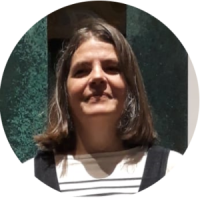
Tracy has completed a Postgraduate Certificate in Peer‑Supported Open Dialogue, Social Network and Relationship Skills (POD). She brings lived experience as a family member to her work, helping to drive change in mental health services towards approaches that are compassionate and relational.
Drawing on her background in teaching, Tracy is involved in developing and delivering POD training within the Devon Partnership Trust . She has worked with both ODDESSI trial and APOD study research sites, supporting the practical application of Open Dialogue principles across training and service contexts.
Tracy is a co founder of ODISC, which is a collaboration between healthcare practitioners from the NHS involved in the ODDESSI trial, researchers based in the UK, and health, social care and education practitioners who are interested in the potential of Open Dialogue to be used in school settings and beyond.