Five Years In: What It Took to Build the Open Dialogue Centre
Five years ago I sat in a room trying to explain Open Dialogue to a funder, and watched their eyes glaze over. We had little Australian evidence, no formal demonstration site, and no easy way to explain what we meant by “Open Dialogue” to anyone outside a clinical room. Underneath all of it was one simple idea: that people experiencing distress should be met by their community, not passed through a system. What we had, at that point, was one major philanthropic funder prepared to back that idea before we could prove any of it.
That funder was Grant Family Philanthropy, and its founder, John Grant. I want to use this moment — five years on — to reflect on what that early act of trust actually made possible.
Backing an idea, not a program
Philanthropy often backs something you can already see working: a program with a track record, a service with outcomes data, a model that’s been proven overseas and needs replicating in Australia. But what GFP did was different. They funded years of groundwork — building relationships with services, families and communities, testing ways to explain a complex idea, working out what an Australian version of Open Dialogue looked like in practice.
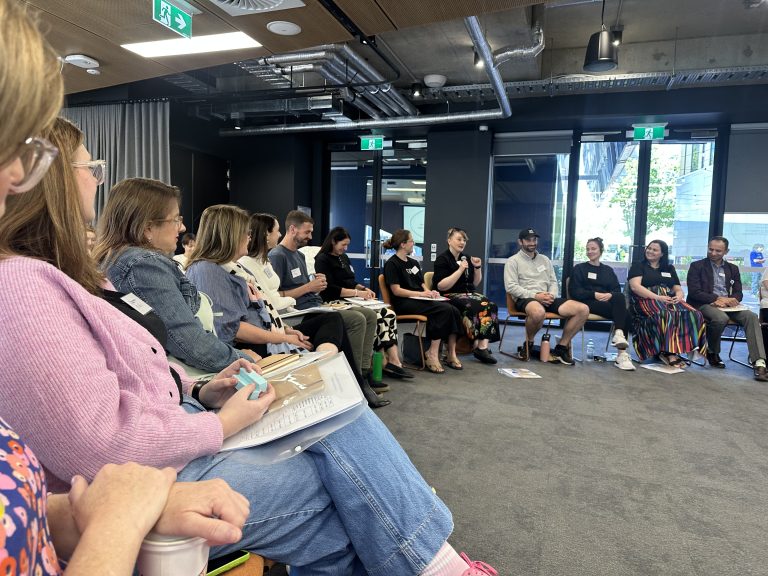
That patience gave us something we wouldn’t otherwise have had: time. Time to test how we described Open Dialogue, and get it wrong more than once. Time to run our first training cohort and learn — sometimes the hard way — what it takes to hold clinicians, peer workers, community leaders and young people in the same room, teaching each other. Time to sit with communities in crisis and let them tell us what they needed, rather than arrive with a solution already designed.
What that early support built
What’s grown over the last five years is a whole-of-region response taking shape in Shepparton, where the William Buckland Foundation backed Goulburn Region Open Dialogue Connect (GRODC) with a significant multi-year investment — and now the same way of working has potential in Queensland and New South Wales, with mental health services, schools, juvenile justice services, Youth Foyers and community organisations each finding their own version of what it means to meet a young person through their community rather than a crisis system.
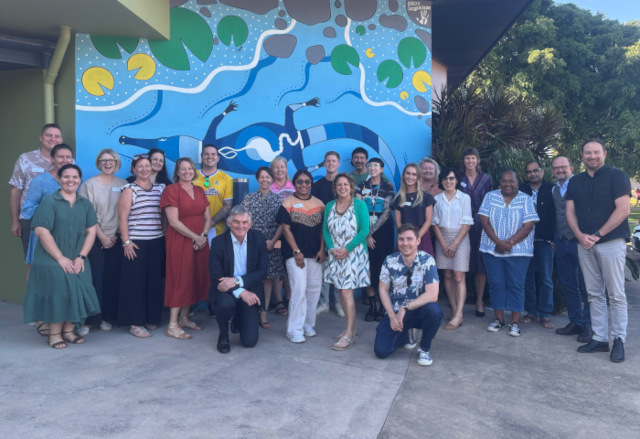
In Townsville local services are taking part in Open Dialogue discovery days and training because they want to work out how to respond together rather than separately. And because young people in Youth Foyers touch almost every part of the system — health, housing, education, justice — there is an opportunity to make sure they only need to tell their story once, not over and over to different services.
A bigger shift
We’re not building this in isolation. Australia’s mental health system is in the middle of a hard, necessary conversation — one the Productivity Commission and Victoria’s Royal Commission have both pushed forward — about moving away from crisis-driven, medicalised responses and toward care that’s relational, integrated, and genuinely community-led. And therefore one that is more preventative and that ultimately will cost our health and welfare systems less money. Open Dialogue didn’t create that shift. But it gives services and communities a concrete, practised way to make it real.
We’ve also been watching closely as the UK’s ODDESSI trial — the first large-scale randomised study of Open Dialogue inside a mainstream health system — nears completion. Its findings will be noticed. But I’m conscious that our own investment came before that evidence, not after it. It says something about what it takes to move a good idea from the margins into the mainstream: someone has to be willing to act on conviction, ahead of the data.
Where we stand
Today, ODC works alongside services and communities from Shepparton to Queensland to New South Wales, each testing what it means to embed, adapt and scale a genuinely community-based response to mental distress. None of that would exist without a founding funder willing to invest in an idea rather than a program, and a project partner willing to back it once it had taken shape. We remain very open to others who might want to back the next stage of this work the same way it started: with conviction but now also with proof.